
Why Apple is Apple?
My curiosity took charge, and what followed was a 800-word rabbit hole.

The logo, the finishing, the ringtone, even the earbuds dangling and you know it’s Apple. After all, what’s the big deal about them? It’s just a brand. Or so I thought.
So what’s in an Apple device iphone for that matter, really? Like, really?
I’m sure you’ve held one and gone, “Man!” or maybe not. Fun fact: I was amazed.
Take the rounded corners. Actually, they aren’t just “rounded”, they’re squircles (square + circle). Why? Because that shape produces softer highlights by minimizing light reflections. And this design choice flows into app icons, screen layouts, even the UI grid. Apple’s design isn’t just what you see rounded corners, minimal icons, sleek finishes. It’s how the device works with you. Design at Apple is not surface-level beauty, it’s functional elegance. Furthermore, Apple doesn’t stop at “good enough.” A design goes through multiple prototypes, digital and physical, each tested, tweaked, and refined over weeks. Even the box the iPhone comes in follows Apple’s religion of minimalism and simplicity.
And here’s a fun stat: nearly 70 elements from the periodic table go into making an iPhone. Materials aren’t just picked for performance, but for durability and feel. And even more interesting and a less-talked-about fact: nearly two-thirds of Apple’s users are women. This gender split is more pronounced with Apple devices (especially iPhone and iPad). Anyways, back to the point.
But then I asked myself: does design alone justify why Apple is expensive? Not really. Apple wasn’t the first to make a smartphone, but it remains the most preferred. Why? Because it did the same thing differently. It defined the problem, highlighted the need, then owned both the problem and the solution.
Apple reframed the smartphone from a device that just connected people, into a pocket-sized tool that could enhance everyday life. It didn’t just change tech; it changed buying behavior.
Now, here’s the paradox: I could easily get a phone with the same specs at a lower price or even better specs at the price of an iPhone. For example, I might be paying a premium for a 60 Hz display while another brand offers 120 Hz at the same cost. (But unless you’re tuned into refresh rates, that difference barely matters)
And maybe that’s the point. Apple doesn’t try to please everyone. It appeals to the tech-savvy, the affluent, and those who crave exclusivity. Owning an iPhone isn’t just about features; it’s a status symbol. Pretty obvious, right? We’re wired for social conformity after all.
But here’s the twist: owning an iPhone is only half the story. The other half is how Apple convinces you to want one in the first place.
Apple’s Marketing Playbook
Step inside an Apple Store and you’ll notice something odd. The staff aren’t “salespeople.” They’re guides. Because the actual sell, is not to sell.
And Apple’s campaigns? They don’t shout specs. They tell stories. If you tell me a phone has 256GB, I’ll probably shrug. But if you tell me I can shoot a movie on it like Apple does in its ads, now I’m listening.
Apple’s ads are minimal, emotional, and leave space for the user to fill in the blanks. Their social media? Less about features, more about how the product unlocks creativity, think the iconic #ShotOniPhone campaign.
Psychology also plays a role:
Scarcity effect → limited stock, long queues outside stores.
Halo effect → one hyped product boosts the whole lineup (remember the buzz around the iPhone Air from latest launch?).
Contrast-caused distortion → positioning an ultra-expensive model next to a “slightly cheaper” one makes the latter look like a deal.
Beyond the iPhone: The Ecosystem Trap
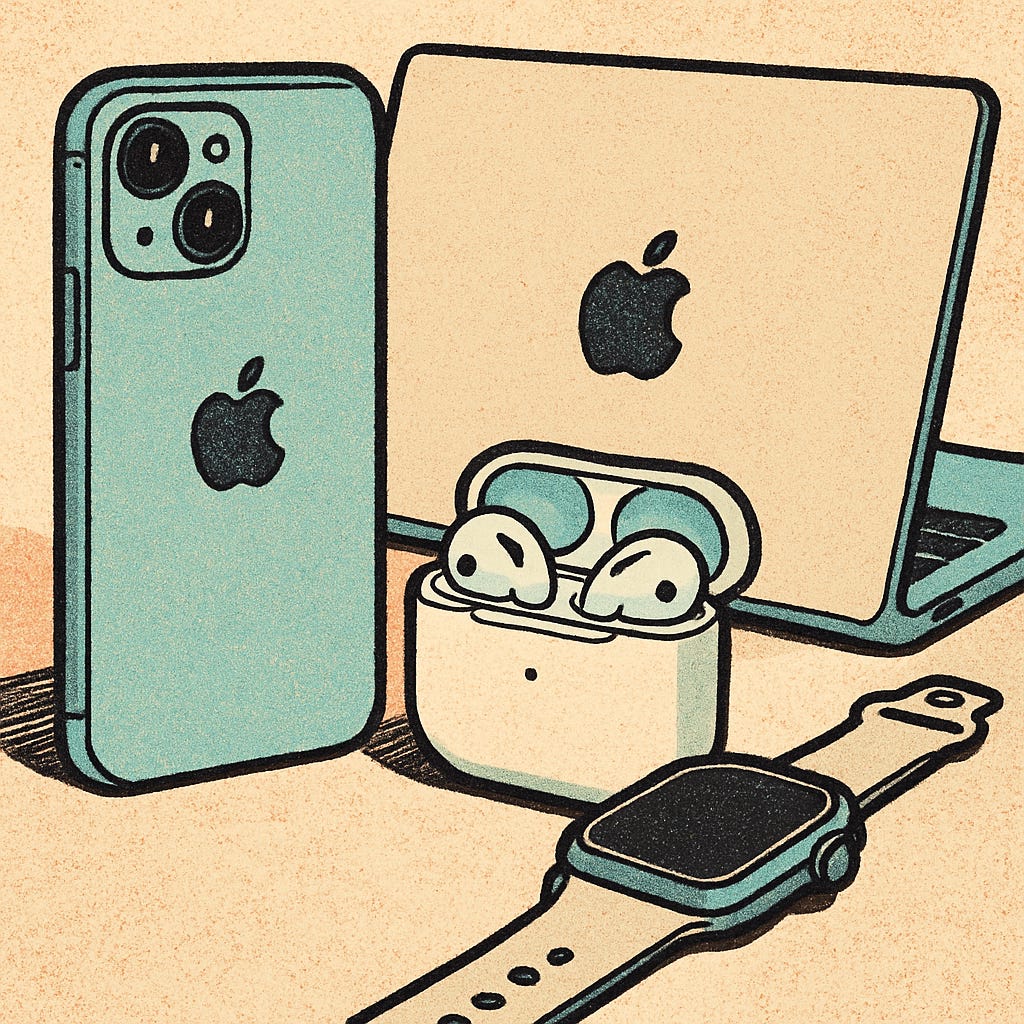
And once you buy that first Apple product, the trap is set. You add AirPods, maybe a Watch, then a Mac suddenly, leaving feels impossible. Not because you can’t, but because Apple’s ecosystem makes it too seamless to give up. AirDrop, Handoff, iCloud, Apple Music all work like magic when you’re inside. Switching costs skyrocket, but more importantly, so does convenience.
You don’t just buy Apple. You buy into Apple.
The Pricing Paradox
Apple follows value-based pricing. Translation: it charges not just for technology, but for the perception of what that technology represents. The product is priced at what people are willing to pay for status, design, and ecosystem. That’s why you probably won't see a price drop when a new model comes out.
So what's in an iPhone, Really?
It’s not just technology.
It’s taste. It’s minimalism. It’s simplicity.
It’s a promise of creativity waiting to be unlocked.
Apple doesn’t sell specs, gigabytes, refresh rates, or pixels.
It sells a story.
As Steve Jobs once said:
“You have to start with the customer experience and work backward to the technology.”
I’m neither an Apple enthusiast nor a skeptic. What fascinates me is the narrative it has woven, a company that doesn’t just make technology, but shapes how we experience it. As the saying goes, the most compelling companies, after all, are the ones that marry tech with taste and Apple has done just that.
Never even ponderer over why I considered I phone as a status symbol before this!
Very cool. Great writing.